Hiển thị các bài đăng có nhãn birds. Hiển thị tất cả bài đăng

Thứ Bảy, 21 tháng 4, 2012

New stamps on Birds


Birds of the Rock

image

Date of Issue : 16 April 2012

Gibraltar Post issued a new set of Definitive stamps featuring birds on 16 April 2012. Though the stamps are definitive but look very attractive !! It is a beautiful set for bird lovers !!

image

Definitive 2012 'Birds of the Rock'

Red-necked Nightjar (Caprimulgus ruficollis) Two species of Nightjar are found in Europe, both of which migrate past Gibraltar.The Red-necked Nightjar breeds only in the western Mediterranean and migrates to tropical Africa during the autumn, returning in the late spring. They are most frequently seen in Gibraltar during levanter conditions. This species feeds mainly on nocturnal flying insects and breeds primarily in open woodlands, favouring Stone Pine woods, which echo at night with its distinctive call.

Little Owl (Athene noctua) This owl, which is found from North Africa and Western Europe to China, is the most common nocturnal bird of prey in Gibraltar. 8-12 pairs breed in cliff habitat around the Rock, and less frequently in holes in old walls. They prey on insects, reptiles and small mammals, and can sometimes be seen during daylight hours. Clutches consist of 3-5 eggs. Little Owls are not migratory and birds are present all year round.

Spotted Flycatcher (Muscicapa striata) This is a migratory species that spends the winter in tropical Africa and returns to Europe to breed in the late spring. Although declining throughout part of its range, the Spotted Flycatcher is a common migrant in Gibraltar. The species began to breed in the Botanic Gardens in 2009 and has done so ever since. Clutch size normally consists of 4-6 eggs. Up to three young have been reared in Gibraltar. In spite of its name the Spotted Flycatcher is streaked rather than spotted.

Gutter Pairs

image

image

image

From Our Readers….

Private covers for special events

Century of Centuries : Sachin Tendulkar

DSCN0538

100 Year of Titanic Tragedy

 DSCN0543

Screenshot_3   : Timir R. Shah – Vadodara : email : trs_shah@rediffmail.com

New Stamps from Bulgaria


100 years of an ambitious project, the liner Titanic

image

Date of Issue : 10 April 2012

The Bulgarian Post  issued a  souvenir sheet  on 10 April 2012  to commemorate the 100th anniversary of the sinking of the legendary RMS Titanic.

RMS Titanic sank in the North Atlantic Ocean on 15 April 1912 after colliding with an iceberg during her maiden voyage from Southampton, UK to New York City, US. The sinking of Titanic caused the deaths of 1,514 people in one of the deadliest peacetime maritime disasters in history.

100 years of the first baptism by fire of Bulgarian aviation in the sky over Edirne

image

Date of Issue : 10 April 2012


20th Bulgarian Antarctic Expedition

image

Date of Issue : 07.04.2012

Europa 2012

image 

Date of Issue : 4 April 2012

image  image

Visit Bulgaria..

( Stamp Booklet)

 image image

: Stamps of Bulgaria

Thứ Sáu, 20 tháng 4, 2012

Western Tragopan on stamps…


image 
 This photograph was recently taken at Great Himalayan National Park. Probably it is the third photograph of Western Tragopan in wild  taken so far in the  world as the species is highly endangered. Courtesy (Photo): Director, Great Himalayan National Park
 
 
image
 
 
The Western Tragopan or Western Horned Tragopan (Tragopan melanocephalus) is a medium-sized brightly plumaged pheasant found along the Himalayas from Hazara in northern Pakistan in the west to Uttarakhand within India to the east. The species is highly endangered and globally threatened.
                                             image image  
India Post and Pakistan Post have issued stamps on this highly endangered species of pheasants. 
 

Western Tragopan (Tragopan melanocephalus) 

Western Tragopan (Tragopan melanocephalus), also called Western Horned Pheasant, is a local resident in western Himalayas.

Size: male 68-72 cm;  female 60 cm.   Weight: male 1.80-2.20 kg;  female 1.20-1.40 kg.

Identification: Typical tragopan, with orange to red collar, red facial skin and white-spotted, black belly. Similar species: Male differs from that species primarily by red facial skin and mostly black base-colour of lower breast to vent, female has a noticeably duller and greyer base-colour to upperparts and, in particular, underparts.

Distribution:

The Western Tragopan is endemic to the western Himalayas, occurring from Kohistan, east through Kashmir into Himachal Pradesh and possibly Uttaranchal, north-west India. In summer it inhabits temperate coniferous and deciduous forests, with dense undergrowth, from 2,400 to 3,600 m. In winter, the Western Tragopan descends to grassy or shrubby gulleys with less snow cover, between 1,300 m and 2,500 m. At present the population is estimated to be less than 5000.

Call: a loud 'way waah', during breeding season. Wailing cry 'waa waa waa', when agitated, repeated a number of times.

Food: Mostly vegetarian. Feeds on fresh leaves, bamboo shoots, acorns, berries, seeds and insects.

Thứ Năm, 19 tháng 4, 2012

New stamps on Birds…


2012  stamps from Estonia

Bird of the Year – Plover

image

The Ringed Plover (Charadrius hiaticula) mainly inhabits  natural landscapes on the seashore and sea islands. The population of the Ringed Plover has contracted from at least 8,000 couples to 1,000 or 2,000 during the past 50 years. Perhaps disappearance of suitable places of nestling on the seashore and robbery are some of the reasons why we find the Ringed Plover more and more frequently nestling in the inland.

The Little Ringed Plover (Charadrius dubius) as a typical inland snipe populates mainly manmade places such as gravel pits, limestone quarries etc. Although the global contraction in the population of the species is connected with climate change, the link between the intensiveness of human activity and the population of the Little Ringed Plover is clearly positive. On the basis of recent population assessments there are 1,000 to 2,000 pairs of Little Ringed Plovers nestling in Estonia.

Belarus

image

Belaru Post will issue a souvenir sheet in May 2012 on 20th anniversary of establishing diplomatic relations between the Republic of Belarus and the Republic of Cuba . The souvenir sheet  features birds from both the countries.

Auction


ITS Postal Auction No.56 – Last Date: 12.05.2012

* No buyer’s premium.
* All readers can take part in this auction.
* Some possible scans of this auction are available at
http://www.flickr.com/photos/its_offers/


* All lots offered in this auction are not from the stock of the Society. It is a part of “ITS Stamp News”, quarterly journal of INDIAN THEMATIC SOCIETY. For further details subscribe this journal and enjoy regular postal auctions in future as well.
* All lots in this auction are Mint Never Hinged, otherwise noted accordingly.
* Minimum bid will be estimated price, as given in last of every lot in Indian Rupees.
* All lots are sold to the higher bidder at one step above the under bidder.
* Bidding increments are up to Rs.100 by Rs.5, Rs.101 to 300 by Rs.10, Rs.301 to 700 by Rs.25 and Rs.701 to above by Rs.50.
* Overseas Readers can also take part. Treat Rs.45 equal to US $1.
* Bids also accepted by Email, but confirmation by snail - mail is must.
* The successful bidders will be notified after closing date and the payment must be made within seven days of receipt of intimation. In case the payment will not receive - in future; his/her bids will be rejected without any prior information.
* All Payments must be within seven days after confirmation of allotment by bank draft in favour of Society and payable at LUDHIANA. Overseas Collectors can make payment through Western Union. Other options are also available for easy payment.

1.    India – 1947 – SG 301 to 303 – Independence – Rs.400.
2.    India – 1949 – SG 309 to 24 – Archaeological Series – Set of 19 issues except 323a – Very fine used – Rs.400.
3.    India – 1950 – SG 329 to 332 – Inauguration of Republic – Used – Rs.200.
4.    India – 1951 – SG335/36 – First Asian Games – USED – Rs.80.
5.    India – 1952 – SG337/42 – Saints & Poets – Rs.1800.
6.    India – 1963 – First Balloon Flight Cover, Bangalore – First Pestalozzi Children’s Village of India in Bangalore – RARE! – Rs.500.
7.    India – 1973 – SG 681/84 – Indian Miniature Paintings – Rs.70.
8.    India – 1973 – SG MS704 – Indipex‘73 – Miniature Sheet – Rs.600.
9.    India – 1974 – SG 707/10 – Indian Masks – Complete set of 4v – Rs. 75.
10.    India – 1974 – SG 739 – V. V. Giri, President of India – FDC with cancellation of Madras – Rs.40.

11.    India – 1974 – SG MS711 – Indian Masks – Miniature sheet – Rs.1000.
12.    India – 1974 – SG MS743 – Centenary of Union Postale Universelle – Rs.1000.
13.    India – 1975 – SG 769/72 – Michelangelo – Se-tenant block of four – Rs.120.
14.    India – 1975 – SG 777/78 – Mir Anees & Ahilyabai Holkar – FDC of 2v – Rs.40.
15.    India – 1976 – SG 814/17 – XXI Olympic Games, Montreal – Complete set of 4v – Rs.75.
16.    India – 1976 – SG 825/28 – Indian Wild Life – Complete set of 4v – Rs.200.
17.    India – 1977 – Complete stamps of the Year – Rs.1600.
18.    India – 1977 – SG 850/53 – Indian Flowers – Complete set of 4v – Rs.80.
19.    India – 1978 – SG 882/85 – Modern Indian Paintings – Complete set of 4v – Rs.80.
20.    India – 1978 – SG 886 – 400th Birth Anniversary of Peter Paul Rubens – Corner stamp with T/L – Rs.60

View  : complete list 

If you wish to sell your unwanted material through this Auction, then you can also send your lots with your estimated price for future “ITS Postal Auctions”. We will charge only Rs.5 per lot on unsold lots and 10% on Realisation (minimum Rs.5).
* Subscribe & read “ITS Stamp News”, fastest growing quarterly journal of Indian Thematic Society. For details please visit
http://itsstampnews.blogspot.com/ OR ITS at http://indianthematicstamps.webs.com/

Indian Thematic Society
Registered with the Registrar for Societies in India
Chapter of American Topical Association, USA
MIG # 3464, Phase Two, Dugri Rd, Ludhiana - 141 013
Phone: +91 161 2521244 Mobile: +91 98728 51244

http://indianthematicstamps.webs.com/ OR http://itsstampnews.blogspot.com/
Emails: indianthematicsociety@gmail.com OR surajjaitly@hotmail.com

Thứ Hai, 19 tháng 3, 2012

Stamps from Bangladesh….


Birds of Sundarbans

Bangladesh New Issue 2011 Page4

Date of Issue : 17 July 2011

Rare animals of Bangladesh

Bangladesh New Issue 2011 Page4

Date of Issue : 17 July 2011

Coins of Independent Sultans of Bengal

Bangladesh New Issue 2011 Page4

Date of Issue : 21 July 2011

Philanippon 2011

Bangladesh New Issue 2011 Page4

Date of Issue : 21 July 2011

Traditional Musical Instruments

Bangladesh New Issue 2011 Page4

Date of Issue : 21 July 2011

Centenary of Dhaka Club

Bangladesh New Issue 2011 Page4

Date of Issue : 19 August 2011

E- Asia 2011

Bangladesh New Issue 2011 Page4

Date of Issue : 1 December 2011

Screenshot_3 : Pradip Jain – Patna - email : philapradip@gmail.com

Thứ Năm, 15 tháng 3, 2012

New pictorial cancellations on animals and birds…


Screenshot_9

African Elephant

From   May 26th to May 28th, 2012, will we held a philatelic exhibition  with the Title ZOOLOGIE (Animals in Philately) at  Mondorf-Les-Bains, LUXEMBOURG. A pictorial cancellation featuring  a African elephant will be available.

image

Common Seal

During a philatelic exhibition at Norderney, Germany, on  April 1st 2012, will be available a pictorial cancellation featuring the common seal (Phoca vitalina).

image

Jackdaw

During  a philatelic exhibition  in Kaltennordheim on May 26th  2012 ,Germany, will be available a new  pictorial cancellation featuring the JACKDAW( Corvus  monedula) ,BIRD OF THE YEAR   2012 in Germany.

Eurasian Curlew cancellation  to be issued on 31st  August 2012

Picture 001

Interested philatelists in the above  cancellations may contact Wolfgang Beyer, Vice Chairman of the German Collector Group ArGe ZOOLOGIE. Mail: Wolfgang.Beyer1@polizei.sachsen.de   Postage rates  are  0,75 Euro AIRMAIL or 2,80 Euro REGISTERED AIRMAIL.

Thứ Ba, 13 tháng 3, 2012

Kingfisher on stamps….


image

Kingfisher on Stamps

- Julian Fernandes

I was just walking down to my office at Hinjewadi, Pune in the early hours of the day and I got a glimpse of a very shy bird – The Kingfisher (the white throated Kingfisher); it is a treat to see for any bird lover especially when its swooping down from a perch to have a meal of worms/insects.

untitled image  untitled

Kingfishers are a group of small to medium sized brightly colored birds in the order Coraciiformes. They have a cosmopolitan distribution, with most species being found in the Old World and Australia.

image

There are roughly 90 species of kingfisher. All have large heads, long, sharp, pointed bills, short legs, and stubby tails. Most species have bright plumage with little differences between the sexes. Most species are tropical in distribution, and a small majority are found only in forests.

image image

Many countries around the globe have the Kingfisher as an essential bird to be included in Bird sets (Birdlife / birds set etc).

KF

Some Kingfisher species are:

The White breasted Kingfisher – The call of this kingfisher is a chuckling chake-ake-ake-ake-ake. They are particularly noisy in the breeding season.

Local Names in India are: Hindi: Kilkila, Kourilla;Himachal Pradesh: Neela machhrala; Punjabi: Wadda machhera; Bengali: Sandabuk machhranga; Assamese: Masroka; Gujarati: Kalkaliyo, Safedchati kalkaliyo; Marathi: Khandya; Tamil: Vichuli; Telugu: Lakmuka, Buchegadu; Malayalam: Ponman; Kannada: Rajamatsi .

image

The Pied Kingfisher - is a water kingfisher and is found widely distributed across Africa and Asia. Their black and white plumage, crest and the habit of hovering over clear lakes and rivers before diving for fish makes it distinctive.

Common Kingfisher - This sparrow-sized bird has the typical short-tailed, large-headed kingfisher profile; it has blue upperparts, orange underparts and a long bill. It feeds mainly on fish, caught by diving, and has special visual adaptions to enable it to see prey under water.

- Julian Fernandes,  Pune 

email : Julian.destiny@gmail.com

Philatelic Interests: · Birds, Animals, Flowers, Sea life, Butterflies/Moths on stamps.· WWF stamps.

Australian Water Birds…


Bids

Date of Issue : 6 March 2012

There are 28 species of ducks found in Australia, 10 of these are endemic to Australia.

image

The Radjah Shelduck is a distinctive bird, with its white head, neck, underbelly and eye, and its rich chestnut neck band and back. It is sensitive to human incursions into its habitat, which has led to a decline in its numbers over recent decades.

The Pink-eared Duck attracts much interest for its singularity. Named for the pink area behind each eye, it is a curious looking bird, with fine black and white bars across its body, a dark back and patch over each eye, and a large spatula-like bill. The plumage of males and females is identical.

The Australian Shelduck has glossy black plumage, a chestnut breast and lower back, and iridescent green speculum. The male's head is completely black, but the female has a white ring around her eye and beak. It mostly occupies Australia's more southerly regions.

The Plumed Whistling-Duck has a mainly pink bill and legs, a white belly and long, upswept flank plumes. This tropical duck is highly nomadic, particularly between coastal and interior plains. It is fairly common across northern Australia and east down the coast to the Murray River.

Maxim Cards

image

Thứ Hai, 12 tháng 3, 2012

The animals of the Viking Age….


birds birds

Date of issue : 20 February 2012

The Post of  Faroe Island issued a set of two stamps on 20 February 2012 featuring the animals of viking age.

The Great Auk

The Great Auk was a bird of the genus Alca, which also includes the Little Auk, Common Murre, Razor Bill and Atlantic Puffin. All of these species live or lived in the North Atlantic. The Great Auk was the largest of these birds and could grow up to 70 cm in height. Some of the other Alca birds had bright or whitish abdomens and dark-black backs, with a characteristic white spot on each side of the head, between the eyes and eye socket. They were flightless birds, with wings that were as small as the South Atlantic penguin. It was fast in the water when hunting fish but very clumsy on land.

The Great Auk lived in large colonies along the coast on both sides of the North Atlantic, so far south that remains of the bird are found in Stone Age and Viking Age kitchen middens.

The Great Auk was a summer visitor to the Faroe Islands but there was never any evidence that it bred there. The last bird was taken at Stóra Dímun on 1 July 1808.

There exist a few stuffed examples of the Great Auk, for example Iceland purchased a pair that can be seen today in the Natural History Museum of Iceland. The Zoological Museum in Copenhagen has used the Great Auk as a logo for many years. Ole Worm's Museum Wormianum in Copenhagen was sent a living Great Auk. It was drawn showing a ring around its neck, which meant that it had been tethered.

The Great Auk is an example of a bird that was hunted to extinction purely because of a lack of knowledge about its population distribution. The fishermen of the day cannot be reproached for this, since they did not have the benefit of modern communication technology. But the museums could have perhaps tried to save the Great Auk rather than have helped to deliver the final blow.

Dímun Sheep

The sheep are small and black and look a little like the more primitive feral Soay sheep that live on the island of St Kilda in the Outer Hebrides. They are called the goat-horned sheep, because both sexes have horns, though the ewe’s horns are smaller and more delicate than the ram’s horns. The Dímun sheep are more developed compared to the Soay sheep, which have the wild sheep’s light belly. Woolen garments recovered from Bronze Age burial sites have the same kind of wool and structure that is found on the Dímun sheep, so even at this early stage, wool from these sheep was being used.

The three sheep from Stóra Dímun were among the last of the original sheep in the Faroe Islands, and were perhaps brought by the Vikings. In an excavation in Eiði in the north end of Eysturoy, half a skull of the same kind of sheep was found. The Vikings brought their own sheep to Iceland and Greenland and almost certainly when they came to the Faroe Islands. Around 1600, almost all of the sheep on the Faroe Islands were wiped out by disease. New sheep were introduced from Shetland and Iceland. But the small black sheep on Lítlu Dímun managed to survive, although by 1860 they were finally wiped out by hunting.

Read Mroe…

Thứ Ba, 21 tháng 2, 2012

Sea Birds from South Georgia..


image

To be  issued on  : 21 March, 2012
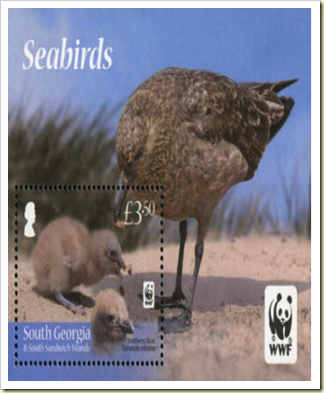
image image


This stamp issue, produced in association with World Wide Fund for Nature (WWF), recognizes some of the lesser-known species of seabird breeding on South Georgia. The species depicted are part of the rich biodiversity found in South Georgia's unique environment. WWF is one of the world's leading conservation organisations who work towards conservation and sustainability.

The cold waters around South Georgia and South Sandwich Islands are highly productive and provide rich feeding grounds for many species of seabirds. Twenty five species of seabird breed on South Georgia (with two additional species, Adélie penguin and Antarctic fulmar, breeding on the South Sandwich Islands) and many vagrant and non-breeding species are also seen around the islands.

Imperial shag (Phalacrocorax atriceps) (60p)

The imperial shag is found in rocky coastal areas and breeds in small colonies in most parts of South Georgia. They are a monogamous species and usually lay 2 -3 eggs (though can lay up to 5). Laying occurs in October/November with eggs taking 5 weeks to hatch and fledging occurring in March. Their nests are made of seaweed and grass glued together with mud and guano. Imperial shags forage mainly in inshore areas (though can also travel further offshore) on small fish, crustaceans, polychaetes, gastropods and octopuses. They dive down to an average of 28m for around 5 minutes to catch their prey, although they have been recorded to dive as deep as 70m.

Antarctic tern (Sterna vittata) (70p)

Distributed throughout the Southern Ocean and common throughout the year around South Georgia, the Antarctic tern start breeding from mid-November to early December with chicks fledging in January. Nesting close to shore in natural depressions in the rock or shallow scrapes in the ground, their eggs and chicks are well camouflaged. These small birds (31-38cm long) are susceptible to human disturbance and to predation of their eggs and chicks by rats, however they will defend their nest sites vigorously, dive-bombing anything passing too close. Feeding in inshore waters, often in the kelp zone, their main prey is small fish but they also take crustaceans, polychaetes, molluscs, insects and algae.

Southern skua (Catharacta antarctica) (95p)

The southern skua is a sub-Antarctic species and is regarded as having a stable population. They are distributed widely around South Georgia but are commonest on offshore islands where there are the greatest numbers of small burrowing petrels. Their hooked beak and webbed feet with sharp claws allow the skua to be a highly predatory bird, which, besides burrowing petrels, feed on penguin chicks and eggs. They will also scavenge on carrion on land as well as around fishing vessels. During the winter, skuas migrate northward, departing in April and returning to South Georgia in September. Egg laying starts in November with chicks fledging in late February.

Kelp gull (Larus dominicanus) (£1.15p)

Kelp gulls are omnivores with their diet depending on food availability. They take and scavenge on small prey including molluscs, fish, crustaceans, other seabirds and even chicks and eggs of their own species. This coastal gull is common throughout the year around South Georgia and inhabits sheltered bays. They build nests lined with vegetation and feathers which are little more than a shallow depression in the ground. Two or three eggs are laid during November to December and both parents raise the chicks. Fledging takes 45-61 days and the young gulls take 3-4 years to reach maturity.

In addition to the set, there is a Souvenir Sheet showing a Juvenile Southern skua (£3.50p) and a sheetlet of 16 (4 sets in staggered format) with face value of £13.20p.

Read More …

Species information from Bird Life International species factsheets www.birdlife.org


Club News

From Our Readers..

maximcard

Srinivasa Ramanujan

Maxim Card prepared by Sanjiv Jain, Dehradun

back side

Labels

11.11.11 covers 2012 - Year of Dragon 999 Covers Air Mail Air-craft Aland Algeria animals Antarctica Expedition APS covers Architecture Argentina Army Army Postal Sevice Art Articles astronomy auctions Australia Australin Territories Austria autographs automobiles Aviation Azerbaijan Bahamas Bangladesh Belarus Belgium Biodiversity birds Blogs Blogs and Websites Book review Books Books and Magazines Brasil bridges Buddhism Bulgaria Campaign Canada cars cartography cartoons Cats Ceramics Chess Children China Chistianity Christmas Cinema Club News Coin Exhibition coins Comics Communication Contests Cook islands Costa Rica Covers Crash Covers cricket Croatia Cuisine Culture customized stamp Cyprus Czech Repub. Dances Definitive Stamps Denmark Dinosaurs Disaster Discussion Dogs Easter Education Energy Environment Error Errors and Varieties Essay Contest Estonia Europa europa 2011 Europa 2012 Exhibits Fashion Fauna FDC's of Miniature sheets FDCs Festival Festivals of India Fiji Films Finland FIP rules Fisheries Flags Flora Flowers Food Food and Cuisine Football Forest France Freedom fighters Fruits G.B. Games Gandhi gastronomy Geography Germany Gibraltar Girl Guides Greece Greenland Greetings health Heritage Heritage building History Holi Hong Kong Horses Hungary Iceland Independence Day Independence Day ; Festival India Indian Stamps Indian stamps 2011 Indian Stamps 2012 Indian theme on foreign stamps Indonesia Industry Insects Institutes and Universities International organizations International Philatelic Exhibitions International Women's Day International Year of Chemistry International Year of Forests Interview Iran Ireland Isle of Man Israel Italy Jainism Japan Jersey jewellery Joint Issue Korea Latvia Letter Boxes Letters Light Houses Literature Locomotives Love Luxembourg Mail Service Malaysia Malta Manali Marine life Martial Art Martyrs' Day Mathematics Max Cards Medical Members meter cancellations Miniature Sheets of India Miscellaneous Monaco Monuments Mozambique museums Mushroom Music My covers Mythiology Nature navy Nepal New Issue New Year New Zealand News News and Views News from Non Philatelic World News; Members Newsletter Norway Number 9 Numismatics Olympic Games paintings Pakistan Papua New Guinea penguins permanent cancellations Personalities personalized stamps Pets Philatelic Books Philatelic Journals Philatelic Societies Philately Philippines Philosophy Photography Pictorial Cancellations Picture Postcards Pitcairn Islands Plants Plants and Trees Poets Poland Portugal Post Cards Post office Postal History Postal service Postal Stationery Precious Stones Press Clippings Pride of India Pride of India Collection Private covers Quiz Railways Rainbow Rainbow Stamp News Raksha Bandhan Religion Rememberance Day Republic Day Romania Rose Rotary Russia Samoa Schools Science Scouting Sea Sepac ships Singapore slovakia Slovenia Smilers Social Service South Africa South Korea South Sudan Space spain Special Cancellation Special Cover Special Days Special Days;World Post Day Special Events Special Year Sports Sri Lanka Stamp Awards Stamp Booklet Stamp Clubs stamp collection software stamp design copetition Stamp Exhibitions Stamp Exhibitions; Stamp Exhibitions; sports Stamp Fairs Stamp Magazine Sweden Switzerland Tagore Taiwan Taj Mahal Technology Temples Thailand Tiger Titanic Tourism Transport Tributes Tv shows U.K. UAE UK Ukraine unique stamps United Nations UNPA Uruguay USA Valentine's Day vanuatu Vietnam War Wildlife Winter Sports Women world Earth Day World Champiuonships World Heritage Sites World Philatelic Exhibitions World Philatelic Exhibitions; News WWF Zodiac Signs